

This is the opinion of Prosperous Way, not an official voter guide. Please read the official voter guide before you vote.
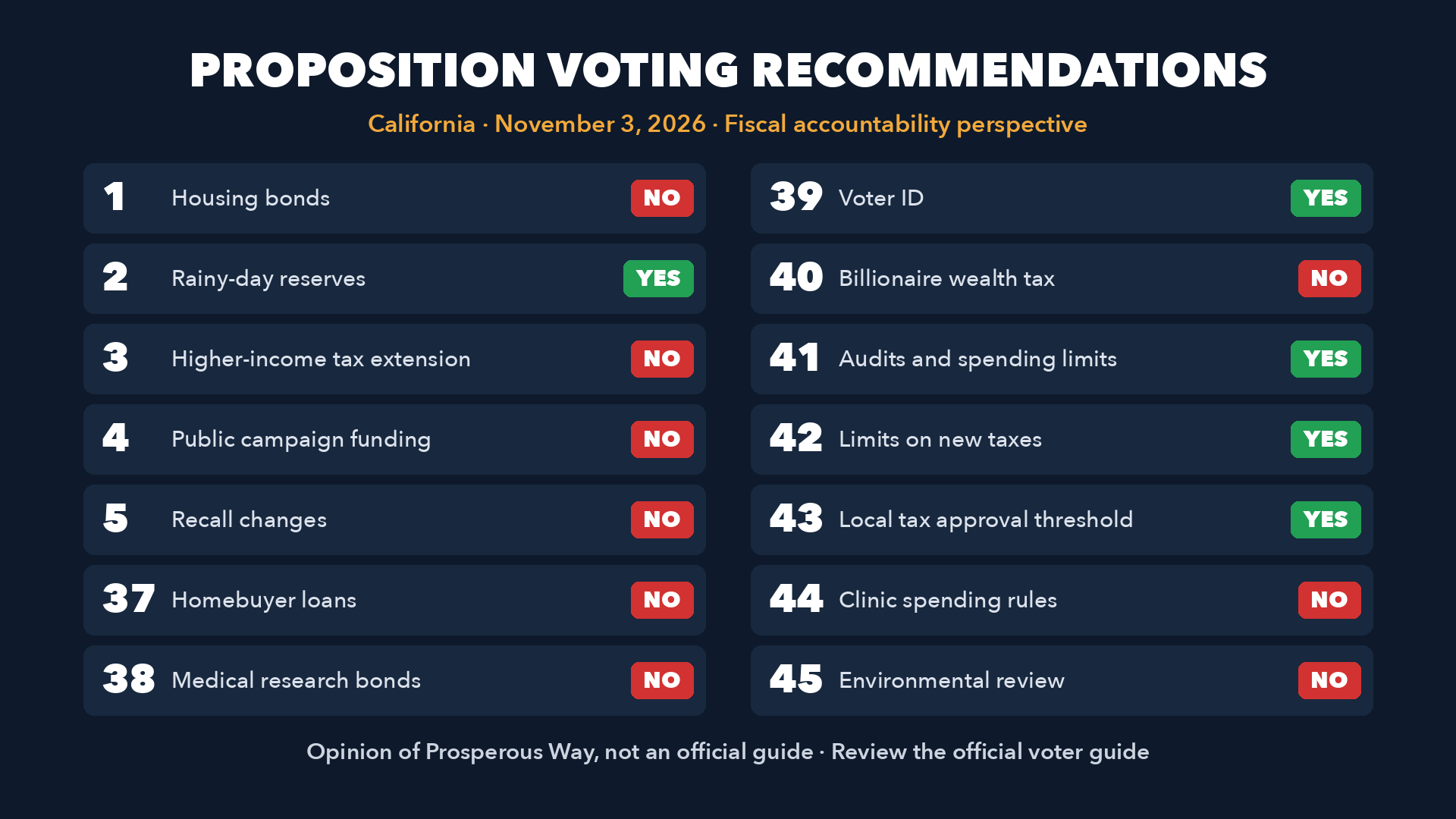
Our positions at a glance
| Prop | Topic | Our position |
|---|---|---|
| 1 | Housing bonds | NO |
| 2 | Rainy-day reserves | YES |
| 3 | Higher-income tax extension | NO |
| 4 | Public campaign funding | NO |
| 5 | Recall changes | NO |
| 37 | Homebuyer loans | NO |
| 38 | Medical research bonds | NO |
| 39 | Voter ID | YES |
| 40 | Billionaire wealth tax | NO |
| 41 | Audits and spending limits | YES |
| 42 | Limits on new taxes | YES |
| 43 | Local tax approval threshold | YES |
| 44 | Clinic spending rules | NO |
| 45 | Environmental review | NO |
The problem
Are you tired of how expensive life is in California, and wondering what we’re getting for our money?
Housing feels out of reach. Healthcare strains our budgets. And too often, our schools, streets and public services fall short of what we expect. We pay so much. Why aren’t we getting better results?
Because spending more money doesn’t automatically solve a problem. Without accountability, it can mean more waste, more bureaucracy, and more money poured into programs without knowing whether they work.
California’s own auditor found serious gaps in tracking the results of billions allocated to homelessness and housing (State Auditor, Report 2023-102.1). And we’ve spent billions on high-speed rail while the promised connection between San Francisco and Los Angeles remains unfinished (High-Speed Rail Authority, 2026 Business Plan).
Our standard
These goals deserve more than good intentions. They deserve results. So before asking us to approve another tax or another multibillion-dollar borrowing commitment, show us what the money we already provided has accomplished.
That’s the standard we’re bringing to this year’s propositions. And when a measure adds no new tax but adds more regulation, more overhead or more bureaucracy, we say no. Those costs show up later, in a slower economy and higher prices.
The analysis, proposition by proposition
Prop 1 · Housing bonds — NO
Eleven and a quarter billion dollars in borrowing, with decades of state repayment costs. No immediate tax increase doesn’t mean no taxpayer cost. We want better evidence of effective delivery before approving more debt.
Prop 2 · Rainy-day reserves — YES
No new tax. It requires the state to save more and pay down debt. That protects us in the next downturn, instead of reaching for another tax increase.
Prop 3 · Permanent higher income taxes — NO
It doesn’t raise today’s rates. It makes a temporary tax increase permanent. Before canceling its scheduled expiration, show us why existing funding isn’t delivering enough.
Prop 4 · Publicly funded campaigns — NO
This allows governments to create taxpayer-funded campaign programs. Reducing donor influence is a legitimate goal, but we don’t consider political campaigns a priority for public spending.
Prop 5 · Recall changes — NO
No new tax, but more process: vacancies would be filled through later special elections or appointments. The official estimate says election costs could swing by millions. More process means more administration.
Prop 37 · Homebuyer loans — NO
Twenty-five billion dollars in bonds to launch a new state mortgage program. The official estimate shows no direct state cost, but it’s still another government program to build and run, doing a job private lenders already do.
Prop 38 · Medical research bonds — NO
We support research. But this commits the state to billions in debt, and potential research revenue isn’t a guaranteed repayment source.
Prop 39 · Voter ID — YES
Yes, it costs money to run. We see that as an investment, not waste. We show ID to board a plane or order a glass of wine. Voting matters more than either. Asking for ID isn’t denying anyone their rights. Only citizens may vote, and these elections shape who represents us, all the way to Washington. Confirming who votes protects fair results, and we believe fair results protect our wallets.
Prop 40 · Billionaire wealth tax — a firm NO
This taxes accumulated wealth, not just this year’s income. In our view, that crosses a serious line on property rights.
The reporting requirement also reaches beyond billionaires: California residents required to file a 2026 income-tax return must declare whether their net assets exceed the billion-dollar threshold. That’s not a detailed inventory from everyone. But it’s broader than the headline suggests.
Lawmakers can amend the act under specified conditions. That doesn’t let them automatically tax everybody, but we worry that future proposals could target smaller fortunes. And the state’s own analysis acknowledges that some billionaires could leave, reducing ongoing income-tax revenue.
Prop 41 · Audits and spending limits — YES
Audits cost money, and savings aren’t guaranteed. But we consider independent scrutiny a justified expense before asking voters to fund more programs.
Prop 42 · Limits on new personal-property and retroactive taxes — YES
This sets boundaries on future taxation. That aligns with our concern about government expanding its claims on accumulated wealth.
Prop 43 · Higher threshold for certain local taxes — YES
It requires two-thirds approval for voter-proposed local special taxes. It makes some funding harder, but we believe new taxes should require broad agreement.
Prop 44 · Clinic spending rules — NO
It adds state enforcement and penalties, costing tens of millions of dollars a year, paid through fees. An overhead percentage doesn’t prove efficiency, and the official analysis identifies possible clinic closures.
Prop 45 · Faster environmental review — NO
We support reducing delays. But this adds initial public costs, and longer-term fiscal benefits are uncertain. We need a stronger case for that investment.
Our opinion
These are our judgments, not a claim that every government dollar is wasted. Supporting a cause and approving its funding proposal are separate decisions.
We want better schools, effective healthcare, affordable housing and safer communities. And we want every proposal judged by what it delivers, not by what it promises.
What you can do
- Vote by November 3, 2026. Check your registration and find your polling place or drop box at the Secretary of State.
- Read the official guide before you decide. For each measure, skip to the Legislative Analyst’s “Fiscal Effect” and ask one question: what will this cost, and how will we know if it worked?
- Treat bonds as taxes on the future. “No new tax” can still mean decades of repayment. Weigh the total cost, not just this year’s.
- Ask for results first. Before supporting new money for a cause, look for evidence that the money already spent delivered.
- Use our guide as a starting point, not a substitute. Screenshot the card below, compare it with your own reading, and share it with someone who votes.
Sources
- Official California propositions and analyses (Secretary of State)
- Complete Official Voter Information Guide (PDF)
- Qualified statewide ballot measures
- California State Auditor, homelessness report 2023-102.1 (April 2024)
- California High-Speed Rail Authority, 2026 Business Plan
Production note: the video’s background footage is illustrative and AI-generated (Google Veo) and does not depict real events. Narration voice (Google Gemini) and music (Google Lyria) are AI-generated.